

















Is Neurobiology Hard? A Complete Beginner’s Guide for Life Sciences Students
Visualize yourself holding the most intricate, complex, and advanced structure in the known universe in your very own hands, an incredible organ that feels, thinks, dreams, and remembers. That’s our human brain, a central focus in the study of Neurobiology.
For Life Sciences students, Neurobiology is the key to unlocking its intricate mysteries. Yet, just hearing the word “Neurobiology” makes students pause and think for a moment. This field is all about mind-boggling circuits, layers of complex Chemistry and Biology, as well as imagining endless neural pathways.
Neurobiology is not an “impossible” field; it’s just an endlessly fascinating, vast, as well as interconnected field. It is a combination of Chemistry, Biology, Physics, Mathematics, as well as Psychology that enables us to visualize and witness the brain from the mind to the molecules.
Every synapse, every neuron, and every Biological circuit tells a detailed story about who we are, and thus, Neurobiology gives us the map and the routes of the complex brain.
Have you ever wondered how thoughts emerge from just some cells and neurons? Why do our emotions and temperament shape our decisions in life? Or, how does memory form? Then, well, my friend, this Neurobiology journey is for you and only you. Neurobiology is not just a fundamental subject for knowledge; it’s a gateway to one of the most excellent Scientific adventures, i.e., understanding and finding your own self.
Neurobiology is Broad, Not Hard.
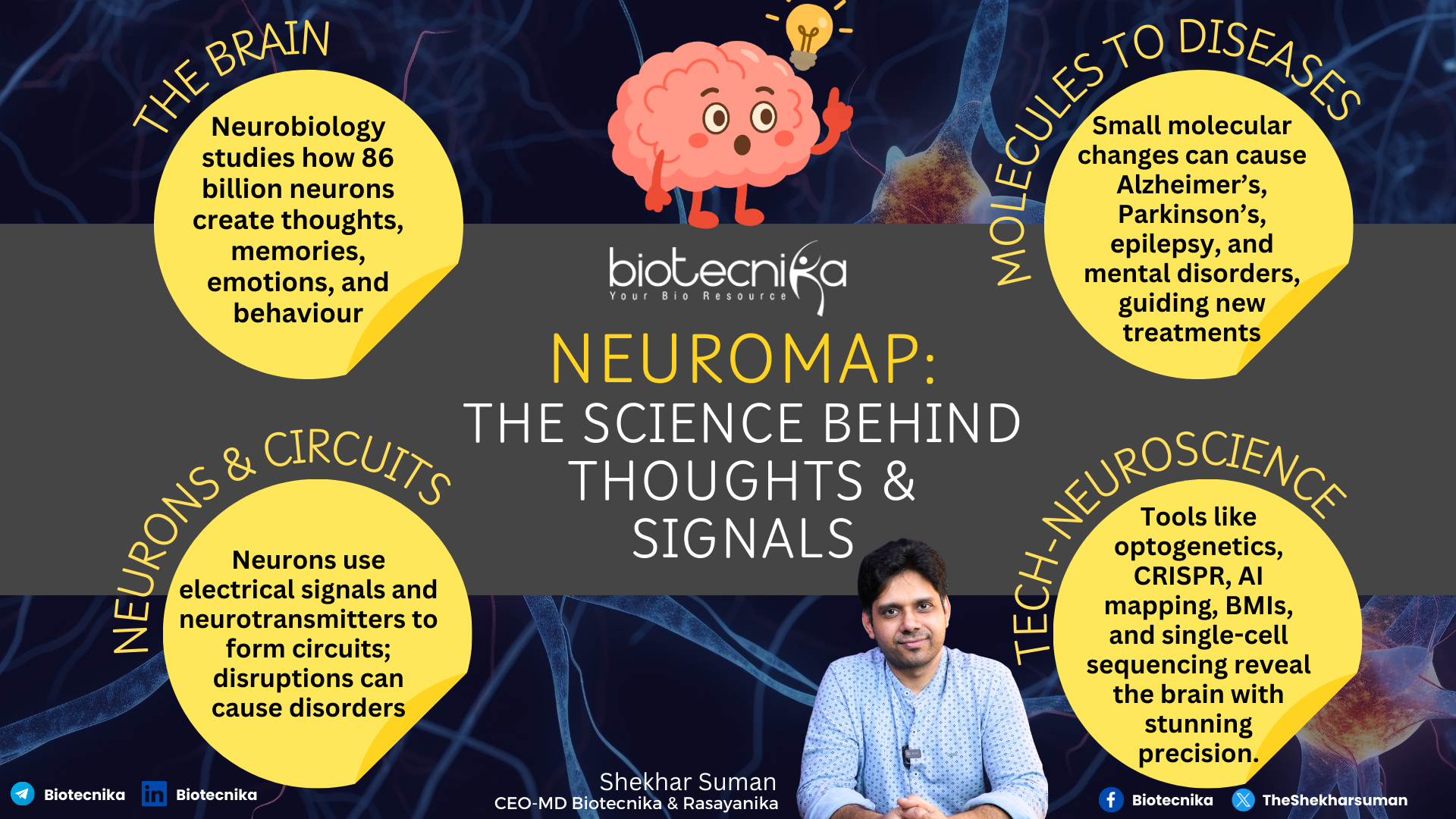
Neurobiology studies and understands the human nervous system and its incredible complexity. The human brain contains a massive number of neurons, roughly 86 billion. These billions of neurons constantly communicate, sending Chemical and Electrical signals, thereby controlling every action, thought, as well as memory.
That massive scale could make you feel intimidated, but it is what makes this unique field so exciting and adventurous.
Think of the nervous system as a busy and electrified city on a map. Our neurons are the tall buildings in the city. Synapses are the junctions and pathways connecting neurons. The neurotransmitters are the messages that traverse across these roads to the buildings. Every part here works in concert, forming a network that keeps the mind active and the body alive.
The major challenge in ‘Neurobiology’ is understanding ‘emergence,’ which is the concept that the whole is greater than the sum of its parts in the brain. Thousands of neurons create thoughts and functionality. Circuits of neurons create memories. And the networks of these circuits create consciousness in us.
Welcome to the wonder of the whole universe: Neurobiology.
Conquering the Challenge
The early courses in Neurobiology may seem challenging at first, but they are designed to lay a strong foundation for the more complex ideas ahead.
These challenges are opportunities to learn and understand how different disciplines of Science connect, practice thinking, and solve problems. With the right mindset and knowledge, every obstacle becomes a stepping stone to greatness.
The major Gatekeeper courses that test your readiness for Neurobiology are:
- Systems or Cellular Neurobiology: It lays the foundation for understanding the brain’s networks and circuits.
- Organic Chemistry: It explains the drug interactions and molecular mechanisms.
- Calculus: It aids in analyzing data and modeling neural dynamics.
These fields of Life Sciences are tough, no doubt, but train your brain, as it is naturally equipped for them. Thanks to ‘plasticity,’ wherein your brain forms new connections whenever you try learning something complicated. Now, combine this with a growth and success mindset and a belief in your abilities, which will improve with effort. Voila, you have the most powerful tools for success.
The Learning Roadmap of Neurobiology
Visualize Neurobiology as a building, and you want to reach the top, so you start climbing up step by step, one at a time. Similarly, Neurobiology starts small with cells and molecules, then moves up to systems and circuits, and, lastly, studies how the brain controls emotions, behavior, and thoughts.
Each step builds on the last, making the big picture more straightforward to understand and interpret.
Layer 1 – Cells & Molecules
This is the foundation of Neurobiology. You learn how neurons communicate using Chemical messengers (i.e., neurotransmitters) and electrical impulses (i.e., action potentials). Synaptic transmission, ion channels, and receptors form the core of Neurobiology.
Layer 2 – Systems & Circuits
Neurons combine to form circuits that control specific functions of the body. Systems such as the hippocampus help us create memories. The visual or eye system allows sight. Understanding these intricate circuits helps us link structure to function in the body. Some famous case studies, such as that of ‘Patient HM,’ have shown that damage to specific areas of the brain can affect a person’s behavior and memory.
Layer 3 – Behavior & Brain
This vital layer integrates the nervous systems to produce a person’s behavior. This section explores learning, motivation, emotions, as well as cognition. Questions like Why do we feel pleasure or fear? How do habits form? Why do some feelings feel so strong while others feel hollow? This is where the brain meets the mind, and magic happens.
As you follow this foundational path of Neurobiology, the brain’s complexity and reasoning become clearer and understandable. The minuscule signals in our neurons connect to whole circuits that ultimately lead to actions, thoughts, and feelings. This journey takes time and is complicated, but each vital step reveals something amazing about our brains and the world.
Your Neurobiology Practical Toolkit – Skills and Research Methods
Neurobiology is more than memorizing facts and rote learning the pathways. You need a robust skill set to explore the brain and its complexities. Executing experiments, analysing and reading data, as well as interpreting graphs, are all part of the job of a Neurobiologist. These skill sets help us understand and witness how our brain actually works, not just in theory but in real, practical life.
Success in the field of Neurobiology requires a broad skill set, not just memorization of theory.
Some Life Sciences & Neurobiology essential skills include:
- Understanding Statistics and graphs.
- Writing clear scientific reports.
- Interpreting and reading datasets.
Research methods include:
- Imaging Tools: EEG, MRI, and fMRI reveal the living brain in action.
- Laboratory Experiments: Work with animals, cells, and tissues to test Brain hypotheses.
- Case Studies: Phineas Gage taught us how frontal lobe damage alters personality.
Every dataset and experiment you work with strengthens your skill sets. These skills help you in Research, medicine, or technology. They turn curiosity into discoveries and ideas into tangible results.
Life as a Neurobiologist
The workload of a Neurobiologist can be demanding in the industry, encompassing laboratory work, lectures, reading, and problem sets. Time management is key. Hands-on Research experience is non-negotiable. Lab work builds critical thinking and opens doors to advanced studies or careers in medicine and Neuroscience.
You may thrive if you enjoy:
- Understanding how systems connect.
- Experiments and practical work.
- Solving complex puzzles.
You may struggle if you dislike math, analytics, or hands-on work. An honest self-assessment helps you succeed and choose the right path. Balance is key. Life Sciences students who do best are curious, willing to try, and enjoy hands-on learning. If you manage your time and stay focused, you’ll find studying Neurobiology exciting, rewarding, and never dull.
Careers & Future Trends: Why Neurobiology Matters in 2025+
Neurobiology is not just a degree; it is a doorway to the future. The brain is central to health, technology, and Research. Studying it today prepares you for jobs and discoveries that will shape tomorrow. The field of Neuroscience is growing rapidly, offering diverse and high-value opportunities.
Choose Your Perfect Track
- Behavioral & Cognitive: Focus on human behavior, memory, as well as perception.
- Systems & Computational: Focus on large-scale data, Coding, as well as brain mapping.
- Molecular & Cellular: Focus on Neuropharmacology, Genes, as well as Proteins.
The Technology Edge
- Large-scale brain mapping projects regularly study billions of Neural connections.
- Advances such as Machine Learning and NeuroAI help analyze complex brain datasets.
- BCIs (Brain–Computer Interfaces) connect minds to machines.
Mental Health & Medicine Innovation
- Biomarkers and New Diagnostics are shaping Personalized Healthcare.
- Psychedelic-assisted Therapy explores novel ways to treat disorders like PTSD (Post-Traumatic Stress Disorder) and depression.
- Precision Medicine and Alzheimer’s Research are transforming treatment.
Career Value & Market Growth
Neurobiology graduates work in:
- Life Sciences, Pharmaceutical, and Biotechnology R&D (Research & Development).
- Pre-health professions such as therapists, Neurologists, as well as Surgeons.
- Medical Device as well as Neurotech development.
- Data Science and Computational Neuroscience
The knowledge and skills you gain now can take you far. You can work in medicine, Research, Biotechnology, or Technology. By learning how the brain works, you help solve critical problems and create new possibilities for the future.
Studying Neurobiology is like climbing a mountain that no one has fully mapped. Along the way, you encounter astonishing puzzles: how billions of neurons coordinate, how consciousness arises, and how behavior emerges. The challenges are real, but the rewards are greater.
Every experiment, every diagram, and every new connection you form changes not only your brain but also your perspective. Neurobiology teaches critical thinking, curiosity, and a deeper understanding of life itself.
If curiosity pulls you toward the brain, trust it. Your brain is plastic. With curiosity, discipline, and persistence, you can master the field and contribute to uncovering its most fantastic mysteries, from consciousness to memory to mental health innovations. Neurobiology is demanding, yes, but it is also inspiring, rewarding, and full of limitless possibilities.









I want to know something about cognitive science and help me with the writing a statement of purpose. I would greatly appreciate.