


















Gut Microbiome Research Takes a Leap with IIT-Delhi–AIIMS’ Swallowable Pill
Do you know an area deep within our human body where a hidden Biological world shapes our Health and immunity, yet has remained largely beyond the reach of Science & Technology? For ages, Researchers and Scientists have known the importance of this area, but somehow lacked an accurate way to explore it. Now, an extraordinary innovation has brought Science fiction a way closer to Medical reality,marking a major step forward in Microbiome Research.
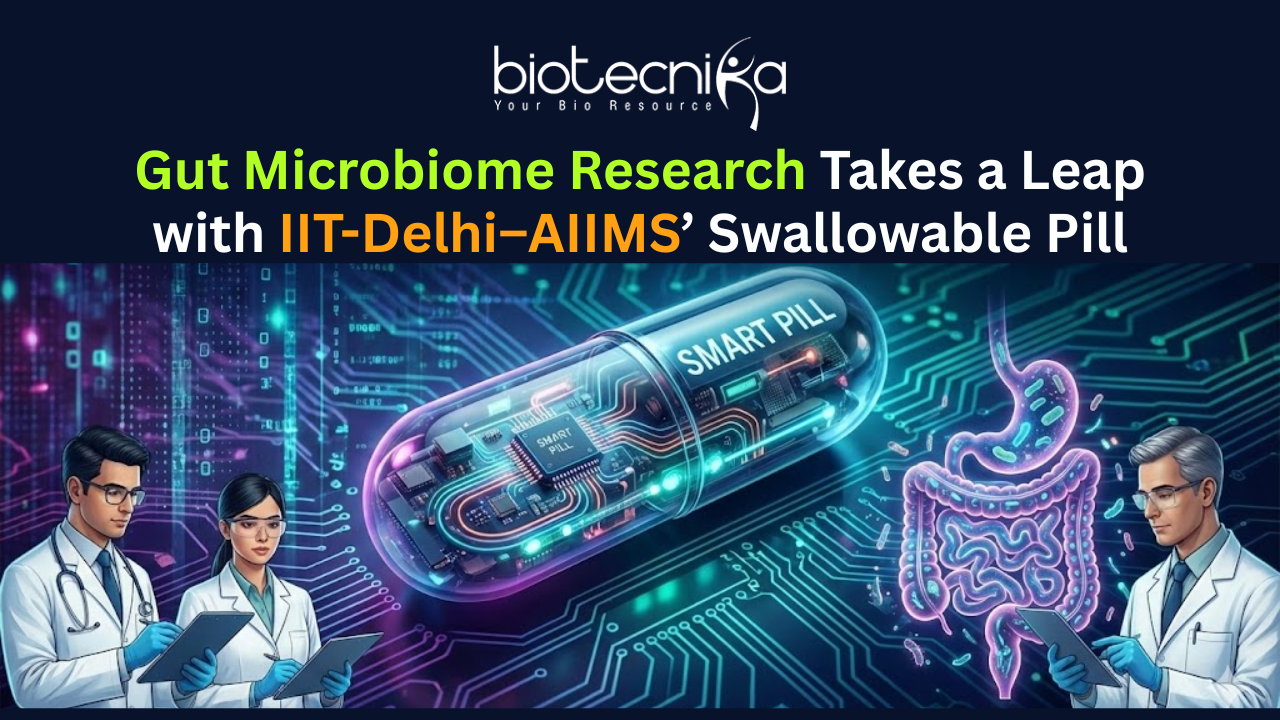
Renowned Researchers from the IIT-Delhi (Indian Institute of Technology) and the AIIMS-New Delhi (All India Institute of Medical Sciences) have developed a swallowable Microdevice capable of collecting microbial samples directly from the small intestine. The epic innovation opens a non-invasive and novel window into a region of the gut that has long remained difficult to study and understand, setting the stage for more profound knowledge into the human Microbiome.
Why Microbiome Research Has Faced Long-Standing Challenges?
Millions of Microorganisms reside inside the human body, and form a vast ecosystem known as the “human Microbiome.” Nearly half of all cells in the human body are microbial, and many of these organisms reside in the GIT (Gastrointestinal Tract), where they regulate various physiological processes, assist in digestion, as well as influence immunity.
Despite their importance, studying these microorganisms has been complex and challenging, especially in the small intestine. Existing Scientific techniques, such as ileostomy or Endoscopy, are invasive, whereas stool-based tests provide only indirect insights and do not accurately reflect microbial activity in the upper GIT.
A Microdevice Designed to Explore the “Inner Space” of the Human Body
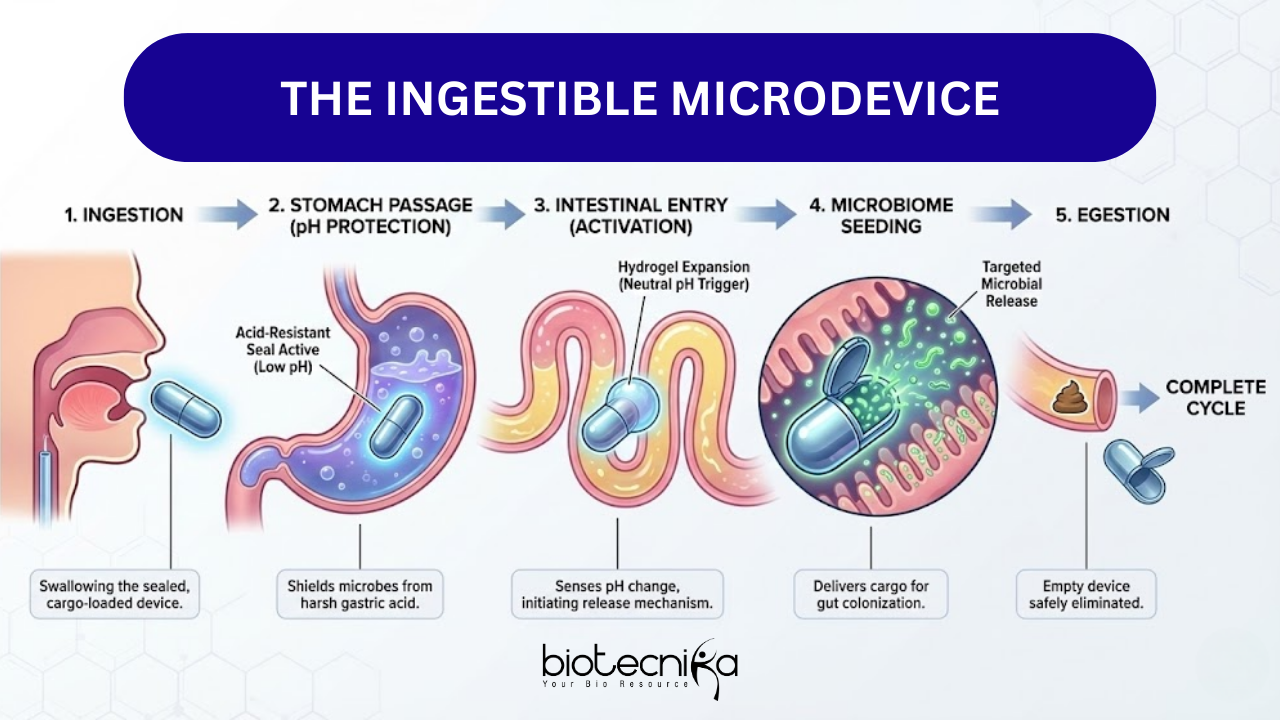
To overcome these limitations in Microbiome Research, Researchers at IIT Delhi developed a pill-like, ingestible Microdevice that can autonomously collect microbial samples from specific regions of the upper GIT.
The Principal Investigator at the Medical Microdevices and Medicine Laboratory (3MLab), CBME (Centre for Biomedical Engineering), IIT Delhi – Prof. Sarvesh Kumar Srivastava stated that “To say there is a hidden universe of living microbes in our body is no exaggeration but a scientific reality – we call it the human microbiome. Just as we send rovers to explore outer space, we need miniaturized devices to explore the inner space of the human body.”
Once the pill is swallowed, the Microdevice remains sealed while passing through the stomach. It opens up only after reaching the small intestine. There, it collects molecular biomarkers as well as bacteria. After sampling is completed, the device seals itself again to protect the collected material as it continues through the digestive tract and exits the body naturally.
Enabling Site-Specific and Species-Level Microbial Analysis
According to the Researchers, the device offers a more accurate picture of gut microorganisms than traditional stool testing.
Prof. Srivastava further explained, “The prototype Microdevice, once swallowed, can autonomously collect microbes from specific regions of the upper GI tract, allowing species-level identification of the residing microbes, among other biomarkers.” This ability enables Researchers to study microbial populations that were earlier challenging to access with precision in laboratories.
This advancement strengthens Microbiome Research by enabling site-specific and species-level analysis of gut microbes that were previously difficult to access.
Microbiome Research Peer-Reviewed Validation and Patent Filing
The Research findings have been published in the international journal Small under the title “A Small Pill-like Ingestible Microdevice for Site-specific Microbiome Sampling in the Upper GI Tract.”
The research team consists of Anshul Nema, Debajit Dhar, Venkata Sai Reddy Ramireddy, Kumari Priyam, Samagra Agarwal, and Sarvesh Kumar Srivastava. They have filed a patent for this novel Gut-Sampling Technology and validated the Microdevice in an animal model. Notably, the device used in validation is no larger than a grain of rice, highlighting its feasibility for safe ingestion.
Clinical Significance and Future Outlook
Co-senior author Dr. Samagra Agarwal from the Department of Gastroenterology and Human Nutrition Unit at AIIMS-Delhi stated, “The small intestine plays a crucial role in Health and disease. Understanding the microbes and chemicals being released there could be key to early disease detection, monitoring of chronic diseases, and developing more targeted treatments.” He highlighted the Medical relevance of this innovation.
Funded by the Indian Council of Medical Research (ICMR), the project is now moving toward further development, intending to advance the Technology for Clinical use in India after obtaining necessary Regulatory approvals.
By offering a non-invasive way to study the small intestine, this innovation marks a significant milestone in Microbiome Research and its future clinical applications. With a pill-sized explorer now venturing where science once could not, microbiome research stands on the brink of a deeper understanding of the human body from the inside out.

