

















Biotech vs Bioinformatics – Which Career Has More Scope?
Biotech vs Bioinformatics: Laboratory experiments or Data-driven Discovery; where do you truly belong?
Choosing the perfect career in Life Sciences feels a lot like standing at a crossroads where the future of Biology, Healthcare, as well as Technology meet.
On one path lies the field of “Biotechnology,” the hands-on universe of incredible innovations, cells, and Biological systems, as well as laboratories. On the other lies the futuristic field of “Bioinformatics,” the world of digital discovery, algorithms, as well as genomes.
Both of these powerful fields promise career growth, global impact, and immense opportunity, yet for numerous students, the question remains the same: “Which career path is right for me and where I’ll prosper?”
The fundamental truth is that the Life Sciences sector is evolving faster than ever globally. Today, Genomes are being sequenced in hours. AI & ML is rewriting Research workflows, and companies are racing to develop smarter Diagnostics, sustainable Biotechnology solutions, and personalized therapies. Suddenly, your choice isn’t just about picking a course. It’s about choosing the kind of future you want to build.
Both are mighty pillars driving breakthroughs in Healthcare, Genomics, Agriculture, and Pharmaceutical Research. Yet, they operate in very different ways. One thrives inside the lab, experimenting with cells and molecules. The other lives inside the digital world, decoding complex Biological information using algorithms and high-performance computing.
As industries become more data-driven and interdisciplinary, students often wonder: Which career has greater scope in the future, Biotech vs Bioinformatics?
What Is Biotechnology?
Biotechnology utilizes living organisms, molecular tools, as well as Biological systems to Research and develop products that would eventually improve lives globally.
From Bio-Pharmaceuticals and Environmental Bioremediation to Genetically Engineered Crops and life-saving vaccines, the field of Biotechnology blends real-world impact with Scientific knowledge.
The major Biotechnology career roles revolve around cell culture, laboratory experiments, protein purification, Drug Development, Genetic Engineering, and R&D (Research & Development).
If you have the thrill of experimental discovery and a passion for hands-on Life Sciences experiments, then Biotechnology provides a tangible and rewarding career path.
Some emerging Biotechnology areas, such as Synthetic Biology, CRISPR gene editing, Bioprocess Engineering, and Stem Cell Technology, are expanding opportunities at a rapid pace today.
What Is Bioinformatics?
Bioinformatics is the field where Biology demands Computational power to solve Life Sciences problems.
It involves using Programming, Algorithms, Data Science, and Statistics to analyze and interpret Biological data. Bioinformatics is particularly in demand for the massive datasets generated by proteomics, genomics, as well as Transcriptomics Research.
Today, DNA (Deoxyribonucleic acid) Sequencing machines can generate terabytes of data in just a few hours. Bioinformaticians turn this generated data into meaningful Biological insights. These interpretations help in improving Precision & Personalized Medicine, identifying disease-linked mutations, as well as predicting protein structures.
If you have a strong inclination towards Machine Learning, problem-solving, as well as Coding, then this digital side of Life Sciences will offer a highly in-demand & future-proof career path.
With AI&ML (Artificial Intelligence & Machine Learning) reshaping Scientific innovation, Bioinformatics is becoming increasingly important to modern Research and the future.
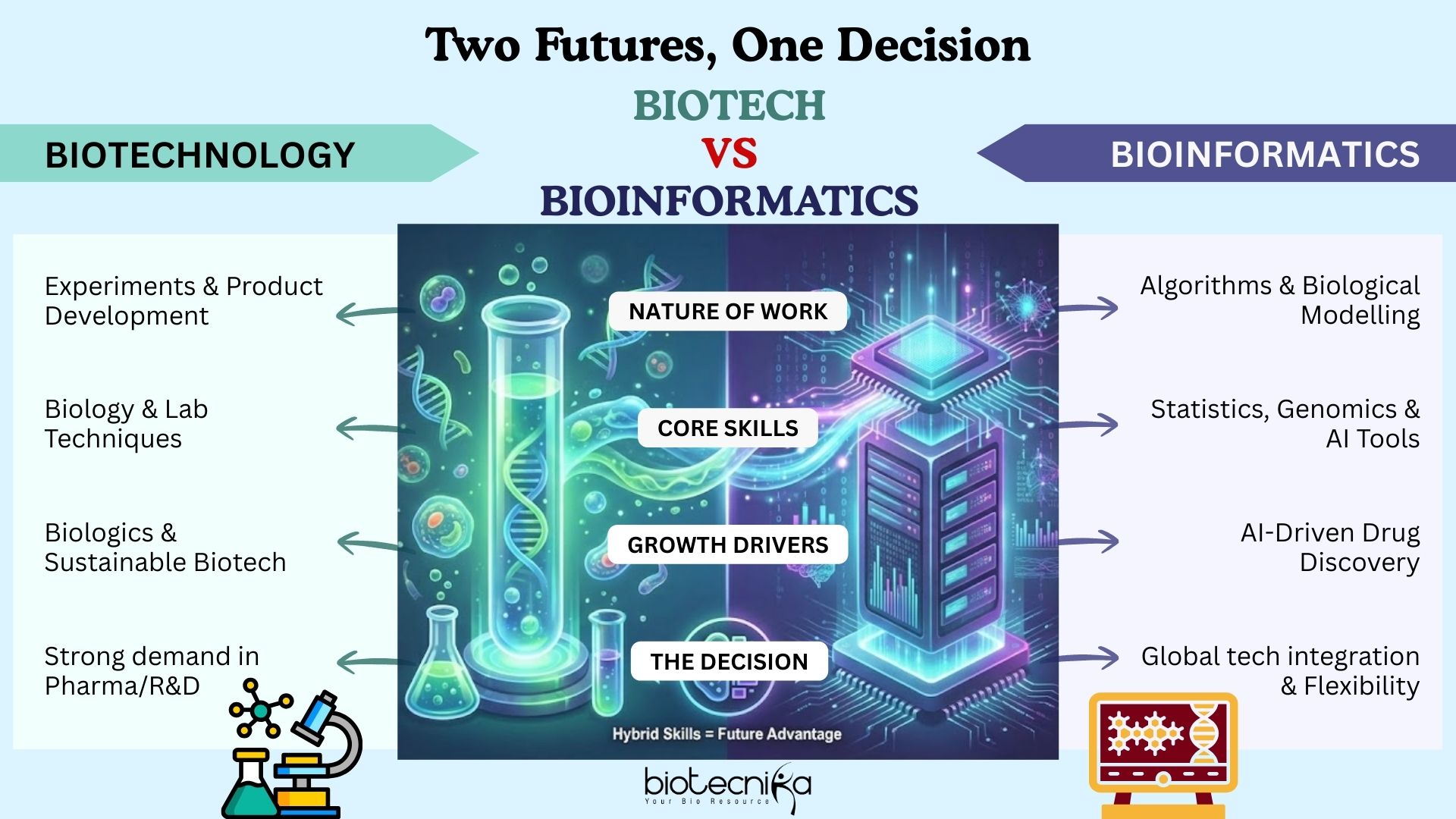
Similarities Between Biotechnology and Bioinformatics
In spite of their fundamental foundational differences, both these incredible fields share several common areas, such as:
- Data-Driven Biology: Biotechnologists rely on experimental datasets, and Bioinformatics analysts analyze and interpret Biological data to guide further Research. Their strong, futuristic collaboration strengthens discoveries in Personalized & Precision Medicine, Drug Development, and Medical Diagnostics.
- Research and Innovation: While decoding Genomic variations or developing therapeutics, both fields contribute to incredible innovations that shape Biotechnology, Pharmaceuticals, and Healthcare.
- Proteomics and Genomics: Both fields study molecular pathways, genes, and proteins. One field studies it through wet-laboratory experiments, while the other field studies it through Computational analysis and interpretations.
Biotech vs Bioinformatics: Key Differences
|
Feature |
Biotechnology | Bioinformatics |
|
Core Focus |
Experimental Research, Biological applications |
Computational analysis, data-driven Biology |
|
Working Environment |
Wet-Laboratory experiments, Laboratory equipment, cell culture, cloning, and molecular techniques.
|
Computers, data mining, Coding, data modelling, and algorithm development. |
|
Skills Needed |
Biology, chemistry, Laboratory skills, analytical techniques, and experimental design. |
Programming (Python/ R), Statistics, Computational Biology, Machine Learning, mathematics |
|
Industry Growth |
Expected global Biotechnology market: $3.4 trillion by 2030 |
Bioinformatics market growing at 14–18% CAGR |
|
Trending Areas |
Gene therapy, industrial Biotechnology, biopharma |
Genomics, AI-Drug Discovery, Precision Medicine |
|
Specializations |
Genetic engineering, Bioprocessing, microbial Technology, drug development, agricultural Biotechnology |
Genomics analysis, AI/ML for Biology, systems Biology, structural Bioinformatics, Computational Drug Discovery |
|
Ideal For |
Students who love hands-on experiments |
Students who enjoy Coding & data |
|
Nature of Work |
Hands-on, product-oriented, experimental. |
Analytical, data-driven, predictive. |
| Job Roles | Biotechnology R&D Scientist, Bioprocess Engineer |
Bioinformatician, Genomics Data Analyst |
Both these fields are expanding exponentially across the world, especially in India, but in different directions. Hence, the best career choice depends on what motivates and inspires you more: Data work or Laboratory work.
Biotech vs Bioinformatics – Career Scope & Job Opportunities
Biotechnology: Growing Demand in R&D
Biotechnology careers continue to expand across India in various sectors, such as:
- Bioprocessing and Biomanufacturing
- Healthcare Diagnostics and Therapeutics
- Regenerative Medicine and Stem Cells
- Environmental Biotechnology
- Pharmaceutical industries
- Food and Agricultural Biotechnology
The Technological rise of mRNA vaccines, Biologics, Sustainable Biotechnology, as well as Cell and Gene Therapeutics, the Biotechnology field ensures strong career growth in the coming years in India.
Bioinformatics: The Data-Driven Future
Bioinformatics is witnessing explosive demand due to:
- NGS (Next-generation sequencing)
- Big Data Analytics in Healthcare
- AI&ML-driven Drug Discovery
- Microbiome Research and Personalized Nutrition
- Precision Medicine
Since the Life Sciences field is becoming more digital and Technology-driven, Bioinformatics career roles are expanding in Hospitals, Pharmaceutical R&D (Research & Development), Biotechnology companies, AI-Healthcare startups, as well as Genome centers.
Bioinformatics is now one of the fastest-growing Life Science careers worldwide, including in India.
Biotech vs Bioinformatics Salary Trends
The salaries vary by location, company, industry, as well as value:
- Biotechnology professionals earn decent salaries in R&D laboratories, Pharmaceuticals, Clinical Research, as well as manufacturing industries.
- Bioinformaticians often seek higher starting packages due to the specialized skill set in Computational modelling, advanced Technology, Coding, and Statistics.
Both fields offer long-term career growth, but the Bioinformatics field has seen a profound rise in demand due to Technological advancements and a global push toward data-driven Life Sciences Research.
Which Career Path Is Better – Biotech vs Bioinformatics?
There is no universal “better.” There is only what is better for you.
Choose Biotechnology if:
- You thrive in a Laboratory environment and tools
- You get excited by vaccines, Molecular Biology, Bioprocessing, or Genetic Engineering
- You want to create real-world Biological products
Choose Bioinformatics if:
- You enjoy analyzing patterns and interpreting them
- You have a passion for Data and Coding
- You want to work in AI-driven Genomics or Drug Discovery
However, the most exciting trend today is the blending of both fields. Scientists who understand both wet-laboratory techniques and Computational tools are becoming the most sought-after professionals in modern Research.
The future belongs to hybrid thinkers who can bridge Biology and Technology, whether through AI in Drug Discovery, Computational Genomics, or integrated bioengineering.
How to Choose the Right Path
Ask yourself:
- Am I more Experimental or analytical?
- What kind of impact do I want to make, novel insights or novel products?
- Do I enjoy Coding or Laboratory?
- Which industries excite me more – Agriculture, Pharmaceuticals, Genomics, or AI-Healthcare?
- What skills do I want to develop, Computational tools or Laboratory techniques?
Your zeal, strengths, and passion will guide you to the right career choice and you’ll succeed in whichever field you enter.
At the end of the day, your career role isn’t just a job position or a degree; it is a reflection of the impact you hope to make, the curiosity that drives you, as well as the problems you want to solve.
Whether you’re drawn to the logic of algorithms or the rhythm of the laboratory, both Bioinformatics and Biotechnology open doors to futures where your work truly matters.
Science today needs thinkers who can decode data and innovators who can transform ideas into reality. Whichever path you choose, you’re stepping into a field that is expanding, evolving, and shaping breakthroughs that will define the next decade of healthcare, agriculture, sustainability, and human biology.
So choose the path that excites you. Choose the one that makes you want to learn more, stay curious, and push boundaries. Because the future of life sciences isn’t built by one field alone—it’s built by passionate minds like yours who dare to imagine what’s possible and work toward it every single day.
Your journey starts with a choice, but what you do with it can change everything.
Student-Focused Biotech vs Bioinformatics FAQs
- Which field has more jobs, Biotech vs Bioinformatics?
-> Both have strong opportunities, but Bioinformatics is growing faster due to Genomics and AI-driven Drug Discovery.
- Is Coding compulsory for Bioinformatics?
-> Yes. You’ll need Python /R, Statistics, and familiarity with databases.
- Can a Biotech student switch to Bioinformatics later?
-> Absolutely. Many students transition through certifications in Python, NGS analysis, or Machine Learning.
- Does Biotech require strong math skills?
-> Not as much as Bioinformatics. Basic quantitative skills are enough.
- Which field is better for remote or international jobs?
-> Bioinformatics offers more remote-friendly and global opportunities because the work is Computational.






It’s very useful information it excited me more