















AI in Healthcare: The IISc Innovation Leading India’s Healthcare Revolution
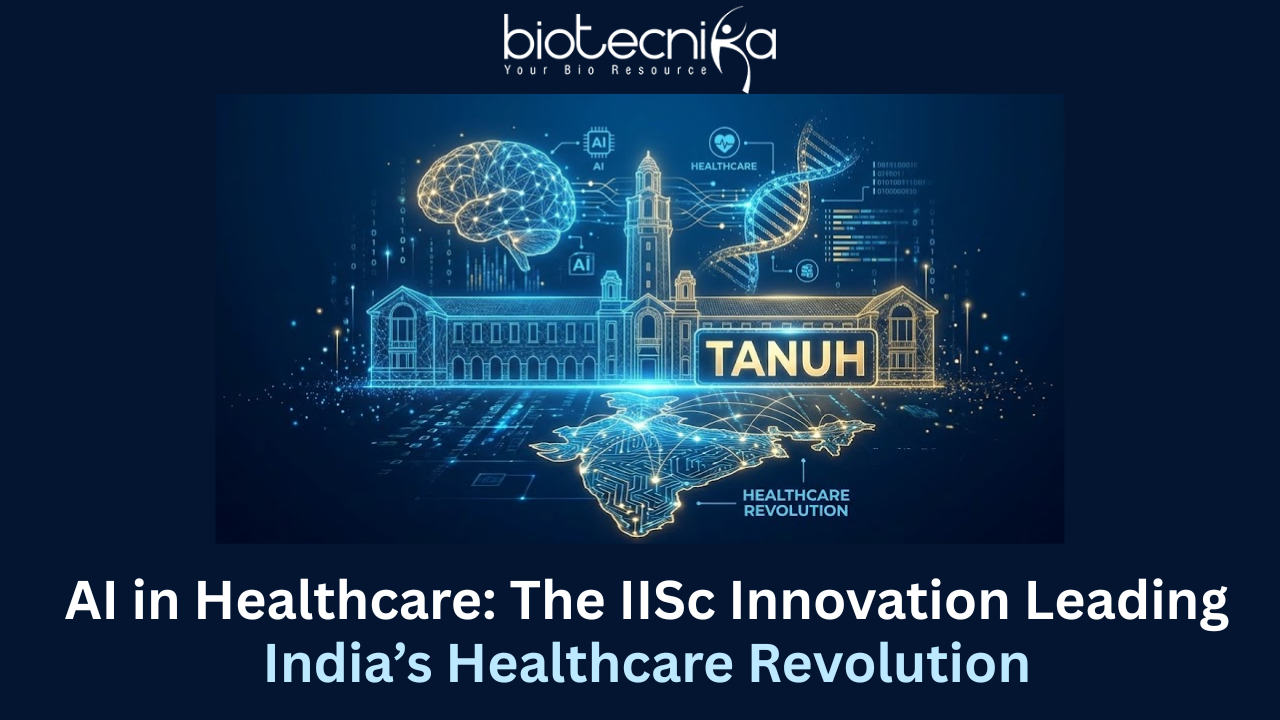
India is moving rapidly towards a future where the Healthcare revolution is powered by AI (Artificial Intelligence) & advanced Technologies. Think of it this way: in the future, we could detect deadly diseases early, frontline health workers could be equipped with innovative AI tools and technologies, and personalized healthcare could reach even remote places. This vision of AI in Healthcare is becoming a reality with the launch of the “TANUH” or Translational AI for Networked Universal Healthcare Foundation.
India’s Bold Step to Revolutionize Healthcare with AI
India is taking a revolutionary, innovative leap in the Healthcare sector. In an incredible initiative, the Ministry of Education has established the “TANUH Foundation” at the IISc (Indian Institute of Science).
This landmark launch established a dedicated AI-CoE (AI Centre of Excellence) for the Healthcare sector. This revolutionary initiative aligns with the Government of India’s visionary strategy of “Make AI in India and Make AI Work for India.”
This futuristic vision aims to involve and utilize Artificial Intelligence to revolutionize the early detection, management, and monitoring of NCDs (Non-Communicable Diseases) across India. By combining Clinical expertise with advanced AI Research, TANUH seeks to develop the Healthcare sector into more accessible, evolving, smarter, as well as faster for every citizen of India.
The milestone establishment of TANUH was officially made public with the signing of a Memorandum of Understanding between the CPMU (Central Project Management Unit) and TANUH on 30th November, 2025.
TANUH is one of four AI-CoE initiatives and was launched by the Ministry of Education, each hosted by prestigious academic Institutions, to encourage AI-led innovation in nationally critical sectors in our country.
TANUH – A Multidisciplinary Hub for AI in Healthcare
TANUH is recognized as a Section 8 not-for-profit company that focuses on deploying and developing scalable AI solutions to manage non-communicable diseases in a patient-centred care setting.
The centre functions as a multidisciplinary core, bringing together Data Scientists, Medical Clinicians, as well as AI Researchers. These professionals ensure that the innovations are clinically scalable, relevant, and Ethical in nature.
Nine IISc faculty members, with esteemed expertise in public health, digital health, and ML, provide the foundation for the centre’s Research programs. They are supported by a core team of Research staff, executives, engineers, and programme managers with substantial industry experience and skill sets.
This structure enables TANUH to translate AI innovations from the laboratory directly to population-scale Healthcare solutions across India.
Tackling High-Burden Diseases with AI-Powered Tools
TANUH’s primary focus is on designing AI-driven tools for early detection, risk prediction, monitoring, and personalized care for high-burden conditions, including Mental Health Disorders, Breast Cancer, Oral Cancer, Retinal Diseases, as well as Diabetes. These tools are specifically developed to support Clinicians and frontline health workers, integrate human decision-making to ensure safe and effective patient care, as well as enhance primary and Hospital care.
The solutions are designed for point-of-care use, adhere to responsible AI standards, and are co-created and validated in collaboration with leading institutions such as AIIMS, New Delhi. This collaborative approach ensures that AI technologies remain grounded in Clinical realities while being scalable across diverse Healthcare settings.
Leadership Insight: Vision of TANUH
Prof. G. Rangarajan, Director, IISc and Chair, Board of Directors, TANUH, highlighted the centre’s strategic importance:
“We are excited to establish TANUH, an AI Centre of Excellence in Healthcare. This multidisciplinary centre will deliver scalable AI solutions for NCDs like oral and Breast Cancer, exemplified by our award-winning Aarogya Aarohan app. TANUH aligns well with the ‘Make AI in India, Make AI Work for India’ vision, and seeks to enable accessible Healthcare across the country.”
His statement underscores TANUH’s commitment to combining technological innovation with nationwide access to healthcare.
Aarogya Aarohan: From Innovation to Real-World Impact
TANUH has already demonstrated its translational focus through the launch of Aarogya Aarohan, an AI-enabled application developed by the centre’s Oral Cancer Screening team. The tool was created in collaboration with AIIMS, ARTPARK, Biocon Foundation, BITS Pilani (Goa), KLE Society’s Institute of Dental Sciences, Triveous, and other clinical and industrial partners, guided by the Oral Cancer Task Force.
Aarogya Aarohan is a white-light, mobile-phone-based AI tool designed to detect OPMD (Oral Potentially Malignant Disorders) and Oral Cancers early. Recognized for its innovation, it won the Best Education Institute Exhibit of the Year at the IMC (India Mobile Congress) in October 2025.
Building Healthcare AI as a Digital Public Infrastructure
TANUH is actively collaborating with Healthcare providers, government bodies, and industry partners to enable large-scale deployment of AI solutions nationwide. By positioning these tools as part of India’s DPI ( Digital Public Infrastructure), TANUH aims to transform Clinical and frontline Healthcare, making care timely, accessible, and effective for all citizens.
With the establishment of TANUH at IISc, India is not just advancing AI Research, it is creating a scalable, Clinician-led, as well as ethically responsible AI ecosystem capable of redefining Healthcare delivery across the nation.