














AI in Biotechnology: Transforming Drug Discovery and Personalized Medicine by 2033
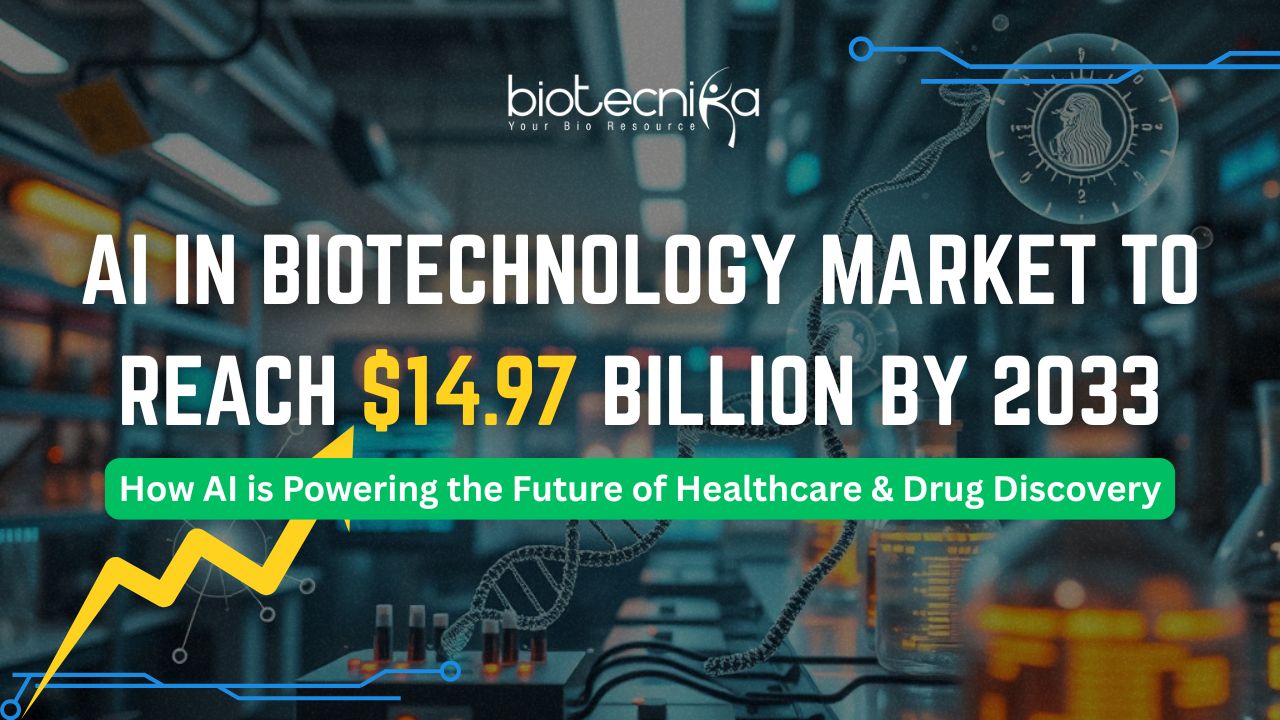
AI in biotechnology is rapidly changing the biotechnology industry in terms of finding, developing, and delivering new treatments. From drug discovery to personalized medicine, AI in biotechnology accelerates innovation and reshapes global health care by mixing technology and life sciences. According to a recent report from Research and Markets, the AI in biotechnology market, earlier projected at USD 3.23 billion in 2024, might now grow to as much as USD 14.97 billion by 2033. The stunning growth rate of 21.1% CAGR alludes to a future where data-driven research, drug discovery, and personalized medicine will be pivotal in modern healthcare.
AI in Biotechnology’s Transformative Role
Using AI in biotechnology is more than an iterative technical advancement; it represents a paradigm shift in the ways research and the healthcare industry operate. Through the analysis of large biological datasets and predictions of molecular interactions, AI in biotechnology systems makes drug discovery faster, more precise, and cost-effective.
Conventional research cannot keep pace with the enormous amount of genomic and clinical data generated each day, which justifies the necessity of AI in biotechnology. Currently, AI algorithms assist researchers in pinpointing targets for drug discovery, enhancing clinical trials, and improving personalized medicine for each patient. This enables it to truly function as intended, considering the genetic makeup and health profile of each patient.
Market Growth and Key Drivers of Artificial Intelligence in Biotechnology
Four major trends have come to influence the advancement of AI in the biotechnology industry:
- Explosion of Biological Data: The rapid rise in genomic and clinical datasets increases the demand for effective AI analytics, supporting drug discovery and personalized medicine advancements.
- Accelerating Drug Discovery: AI significantly reduces trial failures and development costs by forecasting how well potential drugs are likely to perform.
- Personalized Medicine Evolution: With the help of AI, biotech companies and healthcare providers can develop it and tailor it to each individual’s need.
- Automation and Efficiency: From early research to manufacturing, AI in biotechnology streamlines every stage of biotech operations and supports both drug discovery and personalized medicine workflows.
These trends collectively create a smarter, faster, and more precise era of healthcare innovation.
Leading Innovators Driving AI in Biotechnology
Major companies such as Eli Lilly, AstraZeneca, Pfizer, Roche, and Novartis, along with innovators like DeepMind, Insilico Medicine, and Exscientia, are continuously pushing its boundaries. Investments in AI-driven drug discovery and personalized medicine, partnerships, and advanced technologies continue to transform therapy development globally.
According to the Research and Markets report, such developments only reinforce it as an integral part of the future healthcare ecosystem—predictive, personalized, and data-driven. Both will become even more efficient as AI capabilities scale.
The Road Ahead:
By 2033, Artificial Intelligence in Biotechnology will be indispensable for medical innovation. It will lead to wiser drug discovery, more accurate predictions, and stronger personalized medicine outcomes. As data becomes increasingly central to healthcare, AI in biotechnology will reach new heights of efficiency, accuracy, and global impact.
The next generation of biotechnology will rely heavily on AI-powered drug discovery, patient-specific treatment models, and highly adaptive personalized medicine systems that improve healthcare for all.

